
Safeguarding
Safeguarding is Everyone Responsibility
InMAT inspire multi-academy trust is fully is committed to safeguarding and promoting the welfare and safety of all our pupils. We expect everyone associated with InMAT, all staff and volunteers to share this commitment.
We are fully committed to ensuring that consistent, effective safeguarding policies, procedures and practices are in place to support pupils, families and staff in all our schools.
All our schools follow the guidance in Keeping Children Safe in Education (2024), Working Together to Safeguard Children (2023), the Governance Handbook. All staff and volunteers will adhere to the InMAT safeguarding policy, whistleblowing policy and staff code of conduct.
Our CEO is the trust Designated Safeguarding Lead. Our trust Inclusion Lead supports our schools to make sure their processes and procedures are robust and fit for purpose. Each school in our trust has a Designated Safeguarding Lead and a safeguarding governor. We are committed to ensuring that our safeguarding leaders and all staff and volunteers receive the appropriate training to prepare them for their roles.
All our schools will work closely with families for the benefit of the pupils. Staff will make referrals and seek advice and guidance from external agencies such as Social Care if it is deemed necessary. There may be exceptional circumstances when the school will discuss concerns with Social Care and/or the Police without parental knowledge. Our leaders will always aim to maintain a positive relationship with all parents and carers.
If you have a concern about a pupil or a member of staff at Wollaston Primary School, please use the contact details below for the designated safeguarding leader.
If your concern is about a senior leader at Wollaston Primary School, please contact Helen Williams, the InMAT designated safeguarding leader- email:- safeguarding@inmat.org.uk
If you do not wish to speak with a designated safeguarding leader, please email -safeguarding@inmat.org.uk
If you have an urgent concern about a child you can contact the Police on 101, or 999 in an emergency.
You can also contact the Northamptonshire Multi-agency safeguarding hub directly on 0300 126 7000 Or by using the link: Report a concern - Help and protection for children (nctrust.co.uk)
Some other useful links:
Our Commitment
All people who work with our children and on behalf of Wollaston Primary will comply with safeguarding procedures in relation to recruitment, risk assessments, off and on-site procedures, environmental safety, e-safety and as part of their everyday practice with children. It is the responsibility of all staff to know safeguarding procedures, apply the principles in practice, attend training and report any concerns.
All staff will undergo an enhanced DBS check and it is their responsibility to notify the governors if there has been any change in their personal circumstance that make pose a threat to children.
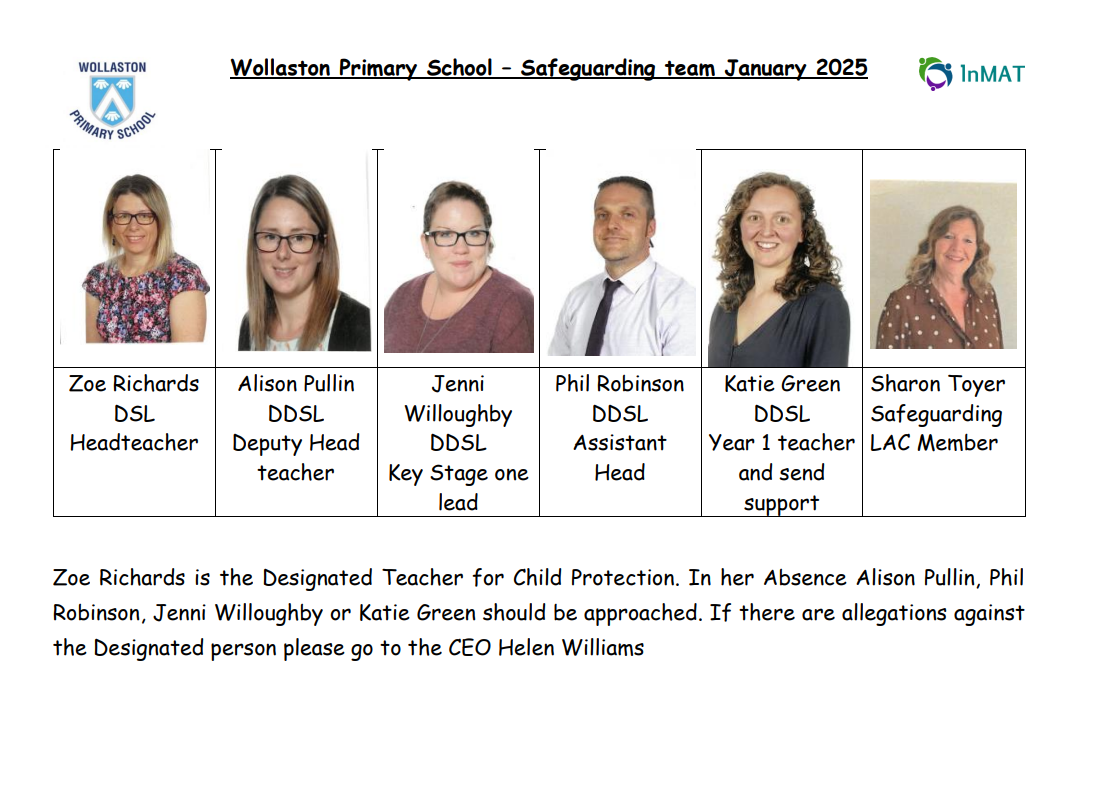
Our Designated safeguarding Leads are:
- Mrs Zoe Richards - Headteacher lead DSL - Zoe.Richards@wps.inmat.org.uk
- Mrs Alison Pullin- Deputy Headteacher DDSL - Alison.Pullin@wps.inmat.org.ukk
- Miss Jenni Willoughby - Foundation and KS1 lead - jennifer.willoughby@wps.inmat.org.uk
- Miss Katie Green - Teacher and SEN Support - katie.green@wps.inmat.org.uk
The Multi-Agency Safeguarding Hub (MASH)
The MASH can advise on whether a family needs early help or whether they meet the threshold for statutory child protection.
Telephone: 0300 126 1000
The Early Help Support Service
The Early Help Support Service is for those working with children and families. We provide information, advice or guidance around:
- Early Help Assessment
- support to create a team around the family meeting (including finding out what other agencies may be involved with the child or family you are supporting)
- access to services, interventions and training.
Telephone: 0300 126 1000
Email:
If we advise that early help is needed, you can use the Early Help Assessment process.
CHILD PROTECTION
All Child Protection concerns need to be acted on immediately. If you are concerned that a child may be at risk or is actually suffering abuse, you should tell one of the Designated Safeguarding Leads at Wollaston Primary School.
All Adults, including the designated safeguarding teachers, have a duty of care by law to refer all known or suspected cases of abuse to the relevant agency including social services or the police. Where a disclosure is made to a visiting staff member from a different agency, such as the School Nurse etc. It is the responsibility of that agency staff to formally report the referral to the School’s Designated Person in the first instance. Recognising Concerns, Signs & Indicators of Abuse Safeguarding is not just about protecting children from deliberate harm.
The witnessing of abuse can also have a damaging effect on those who are associated with any person who may have suffered abuse, as well as the child subjected to the actual abuse. This can and often will have a significant impact on the health and emotional well-being of the child. Abuse can take place in any family, institution or community setting. It can be by telephone or on the internet also. Abuse can often be difficult to recognise as children may behave differently or seem unhappy for many reasons, as they move through the stages of childhood or if their family circumstances change. However, it is important to know what the indicators of abuse are and to be alert to the need to act upon any concerns. Physical Abuse This can involve shaking, hitting, throwing, poisoning, kicking, punching, burning, scalding, suffocating and drowning. It can also result when a parent or carer deliberately causes the ill health of a child in order to seek attention through fabricated or induced illness. This was previously known as Munchhausen’s Syndrome by Proxy.
Emotional Abuse
Emotional Abuse is where a child’s need for security, love, praise and recognition is not met. It may involve seeing or hearing the ill-treatment of someone else such as in Domestic Abuse or Domestic Violence. A parent, carer or authority figure is considered emotionally abusive when they are consistently hostile, rejecting, threatening or undermining toward a child or other family member. It can also occur when children are prevented from having social contact with others or if inappropriate expectations are placed upon them.
Symptoms that indicate emotional abuse include:
- Clingy or attention seeking that is excessive.
- Excessive self-criticism or very low self-esteem or
- Fearfulness or withdrawn behaviour
- Lack of appropriate boundaries with strangers; too eager to please.
- Self-harm or eating disorders
Sexual Abuse
Sexual abuse involves forcing or enticing a young person or child to take part in sexual activities. Whether or not the child is aware of what is happening. This may include physical contact or viewing pornographic material including through the use of the internet. Indicators of sexual abuse include: allegations or disclosures, injuries or disclosure, genital soreness, inappropriate sexualised behaviour including play, words or drawing, and sexually transmitted diseases.
Neglect
Neglect is the persistent failure to meet a child’s basic physical and/or psychological needs that can significantly harm their health and development. Neglect can include supervision that is inadequate, (being left alone for long periods of time), lack of stimulation, social contact or education, lack of shelter, appropriate food, clothing for correct conditions and medical attention or treatment when necessary.
Safer Recruitment & Selection
It is a requirement for all agencies to ensure that all staff recruited to work with children and young people are properly selected and checked. At Wollaston Primary we will ensure that we have a member of the Senior Leadership Team on every recruitment panel who has received the appropriate recruitment and selection training. We will ensure that all of our staff are appropriately qualified and have the relevant employment history and checks to ensure they are safe to work with children in compliance with the Key Safeguarding Employment Standards.